
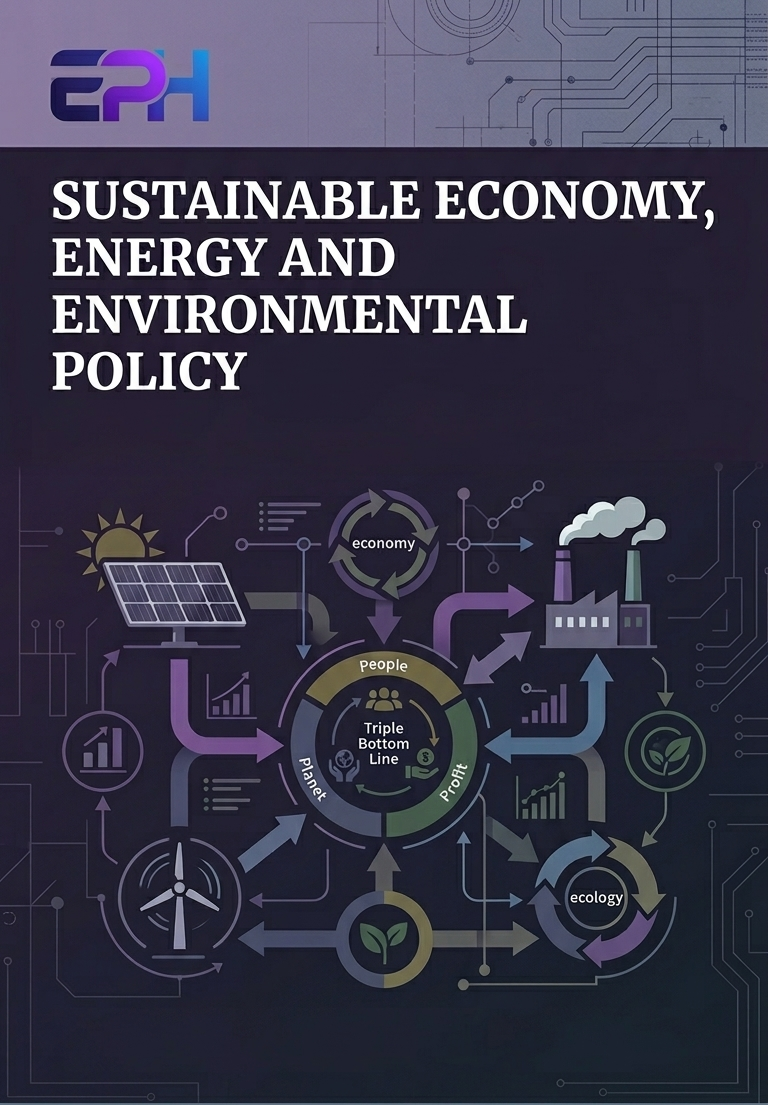
Sustainable
Economy, Energy and Environmental Policy (SEEE)
examines the interconnected dynamics of economic systems, energy transitions,
and environmental governance, placing sustainability at the heart of scholarly
and policy discourse. In an era marked by climate urgency, resource scarcity,
and global interdependence, these domains are inseparably linked, shaping the
future of societies, markets, and ecosystems. SEEE highlights how economic
decisions govern resource allocation and policy design, directly influencing
energy pathways and environmental outcomes. The central challenge lies in
balancing economic growth, social welfare, and ecological integrity.
Energy
choices are pivotal to this transformation. While fossil fuels have
historically powered development, their environmental costs necessitate a
decisive shift. The transition toward renewable sources—such as solar, wind,
and green hydrogen—offers both environmental benefits and new economic
opportunities through innovation, investment, and employment. SEEE emphasizes
energy efficiency, low-carbon development, and resilient energy systems as
essential pillars of sustainable prosperity.
Environmental
sustainability underpins the journal’s mission. Climate change, biodiversity
loss, pollution, and ecosystem degradation reflect the consequences of
unsustainable practices. SEEE advances evidence-based policy solutions,
circular economy frameworks, and governance mechanisms that promote responsible
production and consumption, environmental justice, and intergenerational
equity. By integrating economic analysis with environmental stewardship and
forward-looking energy strategies, the journal contributes to policies that are
both efficient and ethically grounded.
In
addition to high-quality research articles and reviews, SEEE features updates
on emerging technologies, analyses of legislation and regulation, insights into
hardware and software innovations, educational discussions, institutional
profiles, and reports from conferences and global forums—serving as a bridge
between academia, policymakers, industry, and society.
In addition to its scholarly research articles (both short and full papers) and reviews, SEEE also features a diverse array of content. This includes updates on research and technology, discussions of legislation and regulation, insights into hardware and software advancements, coverage of educational topics, literary contributions, profiles of institutions and organizations, and reports on conferences and events.
ISSN: XXXX-XXXX
ISSN Online: XXXX-XXXX
The Sustainable
Economy, Energy and Environmental Policy (SEEE) journal is dedicated to
advancing a holistic understanding of the complex interactions among economic
systems, energy transitions, and environmental governance. SEEE provides an
inclusive platform for researchers, scholars, policymakers, and practitioners
to exchange knowledge and insights that support sustainable development and
evidence-based decision-making across these critical domains.
Aim
The primary aim
of SEEE is to promote interdisciplinary research and dialogue that advances the
following objectives:
Integration
of Disciplines:
Bridge economics, energy studies, and environmental sciences by fostering
research that examines their interdependence and joint impact on sustainable
development.
Sustainability
and Resilience:
Advance innovative pathways for sustainable economic growth, clean energy
transitions, circular economies, and ecological preservation.
Policy
Relevance:
Disseminate research with clear policy implications to support informed,
balanced decisions across economic, energy, and environmental spheres.
Global
Perspectives:
Encourage contributions from diverse regions, recognizing that sustainability
challenges are global and require international cooperation.
Scope
SEEE covers a
broad range of topics within the sustainable economy–energy–environment nexus,
including but not limited to:
Sustainable
and Energy Economics:
Energy markets, pricing, efficiency, and the economics of renewable and
low-carbon systems.
Environmental
and Climate Economics: Policy evaluation, environmental taxation,
market-based instruments, and climate mitigation and adaptation.
Sustainable
Development Policy:
Strategies that align economic growth with environmental protection and social
well-being.
Energy
Policy and Regulation: National and international policy frameworks and their
economic and environmental implications.
Technological
Innovation:
Economic and environmental impacts of emerging energy and sustainability
technologies.
Interdisciplinary
Research:
Integrated studies addressing complex sustainability challenges.
Case
Studies and Best Practices: Real-world applications balancing economic vitality,
energy security, and environmental stewardship.
SEEE is committed to rigorous scholarship, meaningful knowledge exchange, and shaping the global agenda for a sustainable economic and environmental future.
ISSN: XXXX-XXXX
ISSN Online: XXXX-XXXX
Editor-in-Chief
Hussam Bakoben
Department of Finance and Economics, College of Business, University of Jeddah. Saudi Arabia
Associated Editors
Muqaddas Khalid
Lahore Business School, The University of Lahore, Punjab, Pakistan.
ISSN: XXXX-XXXX
ISSN Online: XXXX-XXXX
There is no recent News.
ISSN: XXXX-XXXX
ISSN Online: XXXX-XXXX
Author Guidelines
1. Aims and
Scope
Sustainable
Economy, Energy and Environmental Policy publishes high-quality,
peer-reviewed research that advances knowledge in sustainability, energy
economics, environmental policy, and related interdisciplinary fields. The
journal prioritizes theoretical rigor, empirical robustness, and policy
relevance, particularly in the context of sustainable development and
global environmental challenges.
2. Language and
Academic Quality
Manuscripts must be written in clear, professional English (either American or British, used consistently). Submissions should demonstrate:
Academic rigor
Logical structure
Clarity of argument
Manuscripts
with inadequate language quality may be returned prior to peer review.
3. Manuscript
Types
The journal accepts:
Original Research Articles
Review Articles (systematic or meta-analysis preferred)
Policy Papers
Short Communications
4. Manuscript Length and Formatting
Recommended length: 3,000–6,000 words (including references)
Maximum length: 25 pages
Line spacing: Double-spaced
Font: Times New Roman (12 pt recommended)
Page size: A4 with standard margins
Authors must
ensure conciseness without compromising analytical depth.
5. Title Page
(Submitted Separately)
To ensure double-blind
peer review, the title page must be submitted separately and include:
Title
Concise and informative
Reflective of the study’s contribution
Avoid abbreviations where possible
Author Information
Full names of all authors
Institutional affiliations
ORCID IDs (strongly recommended)
Corresponding
Author
Provide:
Email address
Full postal address
Contact number
Funding
Information
Clearly
disclose all funding sources and grant numbers.
6. Abstract and
Keywords
Abstract
Maximum 150–200 words
Must include:
Purpose
Methodology
Key findings
Policy or theoretical implications
Keywords
Maximum 6–8 keywords
Avoid overly general terms
7. Structure of
the Manuscript
The manuscript
should follow a standard scientific structure:
Introduction
Literature Review
Theoretical Framework / Hypotheses
Data and Methodology
Results
Discussion
Conclusion and Policy Implications
Sections must
be clearly numbered (e.g., 1, 1.1, 1.1.1).
8. Tables,
Figures, and Graphical Content
Must be clearly labeled and numbered
Include titles and sources
Should be high resolution
Must remain interpretable in black and white format
Authors are
encouraged to include conceptual frameworks, robustness graphs, and model
diagrams where relevant.
9. Referencing
Style
The journal
follows the APA (latest edition)
referencing style.
Requirements:
All in-text citations must appear in the reference list
DOIs should be included where available
References must be accurate and complete
10. Data
Availability and Transparency
Authors must
include a Data Availability Statement, specifying:
- Whether data are publicly available
- Repository links (if applicable)
- Conditions for access
Example:
“The data that
support the findings of this study are available from the corresponding author
upon reasonable request.”
11.
Methodological Rigor and Reproducibility
Submissions
must demonstrate:
- Clear description of models and estimation
techniques
- Justification of econometric methods
- Robustness checks and diagnostic testing
For empirical
studies, authors are strongly encouraged to include:
- Endogeneity checks
- Stability tests
- Sensitivity analysis
12. Ethical
Standards and Publication Ethics
The journal
adheres to COPE (Committee on
Publication Ethics) guidelines.
Authors must
ensure:
- The work is original and not under review
elsewhere
- No plagiarism or data fabrication
- Proper citation of all sources
13. Conflict of
Interest
Authors must
disclose any financial or non-financial conflicts of interest.
14. Authorship
Criteria
Authorship
should be based on:
- Substantial contribution to research
design, analysis, or writing
- Approval of the final manuscript
15. Peer Review Process
The journal
employs a double-blind peer review system, where:
- Authors and reviewers remain anonymous
- Manuscripts are evaluated based on
originality, rigor, and relevance
16. Submission Checklist
Before
submission, authors must ensure:
✔ Manuscript is
original and not submitted elsewhere
✔ Title page is separate (for blind review)
✔ Manuscript follows formatting guidelines
✔ References are complete and in APA style
✔ Data availability statement is included
✔ All authors have approved the manuscript
17. Copyright
and Licensing
Upon
acceptance, authors may be required to:
- Transfer copyright or
- Publish under an open-access license (if
applicable)
18. Article Publication Charges (APC)
There is no charges for submission and publication
19. Final Note
The journal
prioritizes contributions that:
- Address real-world sustainability
challenges
- Employ advanced econometric or
analytical methods
- Provide clear policy implications
Submissions
lacking methodological rigor or theoretical contribution may be rejected
at the initial screening stage.
20. Forms
Ethical
Standards and Publication Ethics Form
ISSN: XXXX-XXXX
ISSN Online: XXXX-XXXX
Peer Review Policy
Sustainable Economy, Energy and Environmental Policy is committed to publishing high-quality, original, and policy-relevant research in the fields of economics, energy, and environmental sustainability. To ensure academic integrity and scholarly excellence, the journal follows a transparent, rigorous, and fair peer review process. This policy outlines the principles and procedures used for manuscript evaluation.
Type of Peer Review
The journal adopts a double-blind peer review process for all submissions. The identities of both authors and reviewers are kept confidential throughout the review process. This approach ensures that manuscripts are assessed solely on their academic merit, thereby reducing the possibility of bias.
Selection of Reviewers
Reviewers are selected based on their expertise in the relevant subject area, including but not limited to sustainable economics, energy systems, environmental policy, and related interdisciplinary fields. The editorial team ensures that reviewers have no conflict of interest with the authors or the research. The journal seeks to involve reviewers from diverse academic backgrounds and methodological traditions to maintain balanced and comprehensive evaluations.
Review Criteria
Submitted manuscripts are evaluated according to the following criteria:
- Originality and Relevance: The study should address a significant issue within the scope of sustainable economy, energy, or environmental policy and provide a meaningful contribution to existing knowledge.
- Theoretical and Conceptual Framework: The research should be supported by a clear and well-developed conceptual or theoretical foundation.
- Methodological Soundness: The research design, data, and methods should be appropriate, clearly described, and rigorously applied.
- Analysis and Findings: The results should be logically presented, and interpretations should be supported by empirical or theoretical evidence.
- Clarity of Presentation: The manuscript should be well-organized, clearly written, and consistent with the journal’s formatting and submission guidelines.
- Ethical Compliance: The study should adhere to accepted ethical standards in research, including proper citation and avoidance of plagiarism.
Review Process
- Initial Editorial Screening: Upon submission, manuscripts undergo an initial review by the editorial team to assess their relevance to the journal’s scope, originality, and compliance with submission guidelines.
- Peer Review Stage: Manuscripts that pass the initial screening are assigned to at least two independent reviewers for double-blind evaluation. Reviewers provide detailed comments and recommendations regarding the suitability of the manuscript for publication.
- Editorial Decision: The Editor-in-Chief evaluates the reviewers’ reports and makes the final decision, which may include acceptance, minor revision, major revision, or rejection. Authors are provided with reviewers’ feedback and are given the opportunity to revise and resubmit their manuscripts where applicable.
ISSN: XXXX-XXXX
ISSN Online: XXXX-XXXX
Publish Content