
About
the Journal
The International Journal of Applied
Spatial Econometrics (IJASE) is an international, peer-reviewed journal
publishing high-quality, original research. Please see the journal's Aims
& Scope for information about its focus and peer-review policy.
Please note that this journal only
publishes manuscripts in English.
The International Journal of Applied Spatial Econometrics (IJASE) accepts the following types of articles:
Research Articles
Special issue papers
Review papers
The International Journal of Applied
Spatial Econometrics (IJASE) considers all manuscripts on the strict
condition that
The manuscript must be the author’s original work and must not replicate or duplicate any previously published material, including the author’s own prior publications.
The manuscript must be submitted exclusively to the journal and must not be under consideration, peer review, accepted for publication, in press, or published elsewhere.
The manuscript must not contain any content that is abusive, defamatory, libellous, obscene, fraudulent, or otherwise unlawful.
Please note that the International Journal of Applied Spatial Econometrics (IJASE) uses plagiarism detection software to screen manuscripts for unoriginal material. By submitting your manuscript to the International Journal of Applied Spatial Econometrics (IJASE), you agree to any necessary originality checks that may be conducted during the peer-review and production processes.
Any author who fails to comply with the
above conditions will have their manuscript rejected by the International
Journal of Applied Spatial Econometrics (IJASE).
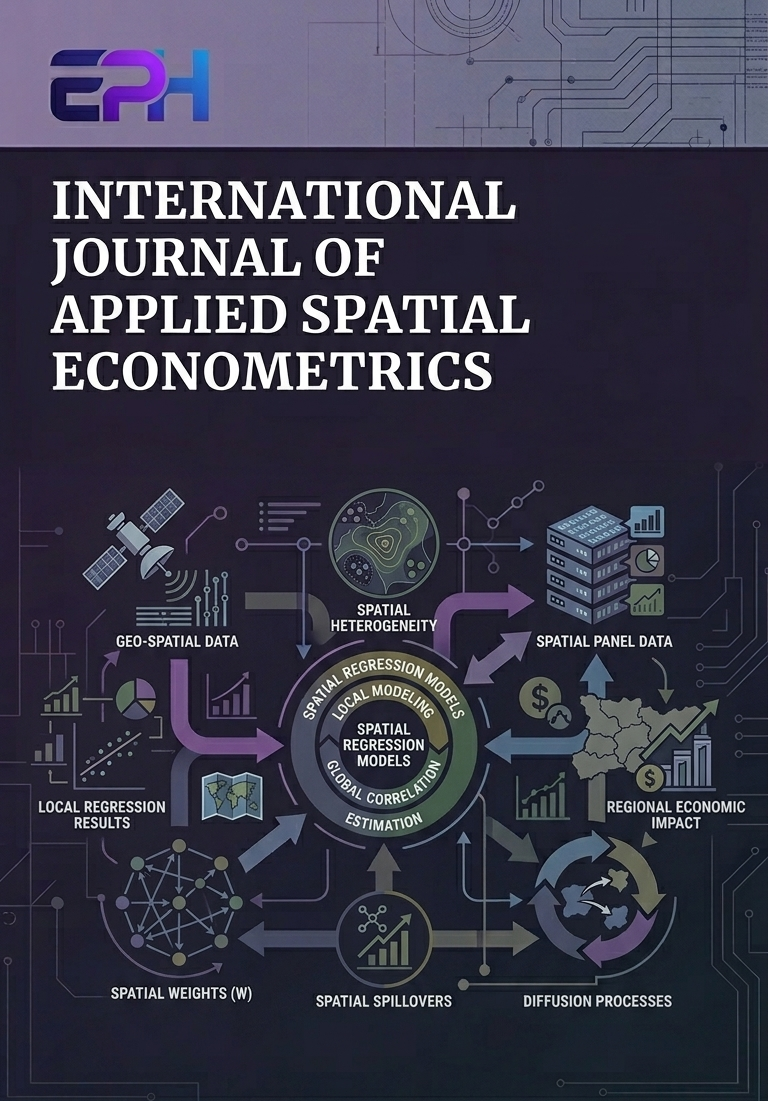
ISSN: XXXX-XXXX
ISSN Online: XXXX-XXXX
The
International Journal of Applied Spatial Econometrics (IJASE) is an
international, peer-reviewed journal dedicated to advancing applied research in
spatial and spatiotemporal econometrics. It provides a platform for
high-quality empirical, methodological, and policy-relevant studies using
georeferenced data to address complex regional, urban, environmental, and
socio-economic challenges, with the aim of improving inference, predictive
performance, and evidence-based decision-making.
A
distinctive feature of The International Journal of Applied Spatial
Econometrics (IJASE) is its emphasis on the integration of spatial
econometrics with machine learning and advanced data analytics, enabling the
analysis of large-scale, high-dimensional datasets and the identification of
complex, nonlinear relationships while maintaining interpretability and
methodological rigor. The journal also prioritizes spatiotemporal modelling,
recognizing its importance in capturing dynamic processes, diffusion mechanisms,
and evolving spatial patterns.
The International
Journal of Applied Spatial Econometrics (IJASE) serves a broad
interdisciplinary audience, including economists, regional scientists,
geographers, urban planners, and data scientists. It is committed to promoting
reproducible research, open data practices, and transparent analytical
workflows.
In line
with its applied and interdisciplinary focus, the International Journal of
Applied Spatial Econometrics (IJASE) also highlights the rapid advancement
of analytical tools supporting spatial and spatiotemporal econometric research,
including:
-
GIS & Visualization
Tools
-
Spatial Econometric &
Statistical Tools
-
Spatiotemporal Modelling
Tools
-
Machine Learning & Artificial
Intelligence for Spatial Data tools
The
editorial board of the International Journal of Applied Spatial Econometrics
(IJASE), therefore, particularly welcomes:
- empirical and methodological advances in
spatial and spatiotemporal econometrics;
- studies on spatial interdependencies in
economic activity, including regional disparities and cross-border
dynamics;
- computational and data-driven approaches for
analyzing georeferenced economic data;
- applications combining spatial and
spatiotemporal econometric methods with machine learning techniques for modelling
complex processes;
- interdisciplinary research connecting
spatial econometrics with fields such as environmental studies,
transportation, urban planning, health economics, and the digital economy;
- applied research using novel data sources,
including geospatial big data, remote sensing, and high-frequency
indicators;
- policy-oriented studies that apply spatial methods to regional development, public health, and economic decision-making.
The
journal also welcomes contributions that replicate or document robustness tests
of studies within the scope of the journal.
ISSN: XXXX-XXXX
ISSN Online: XXXX-XXXX
Publish Content