
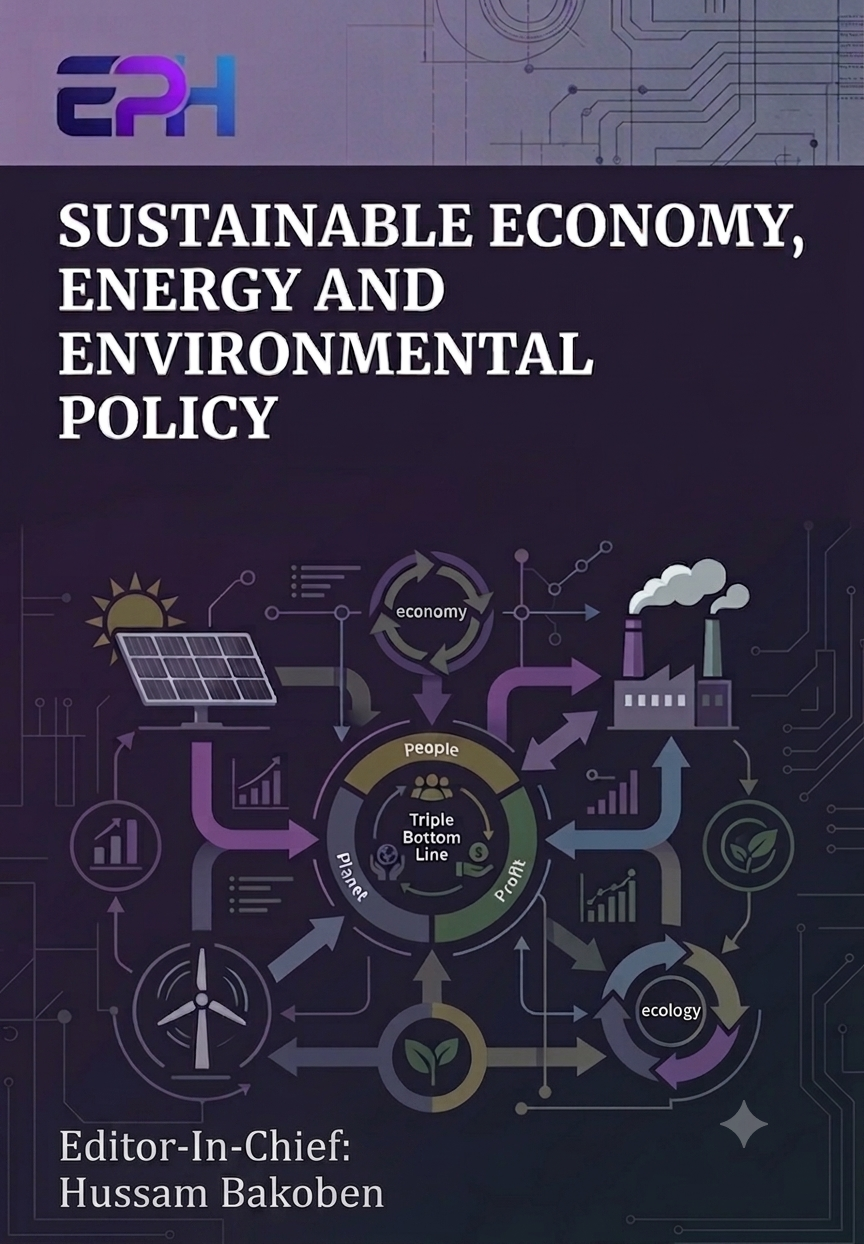
Sustainable Economy, Energy and Environmental Policy
(SEEE) examines the interconnected dynamics
of economic systems, energy transitions, and environmental governance, placing
sustainability at the heart of scholarly and policy discourse. In an era marked
by climate urgency, resource scarcity, and global interdependence, these
domains are inseparably linked, shaping the future of societies, markets, and
ecosystems. SEEE highlights how economic decisions govern resource allocation
and policy design, directly influencing energy pathways and environmental
outcomes. The central challenge lies in balancing economic growth, social
welfare, and ecological integrity.
Energy choices are pivotal to this transformation.
While fossil fuels have historically powered development, their environmental
costs necessitate a decisive shift. The transition toward renewable
sources—such as solar, wind, and green hydrogen—offers both environmental
benefits and new economic opportunities through innovation, investment, and
employment. SEEE emphasizes energy efficiency, low-carbon development, and
resilient energy systems as essential pillars of sustainable prosperity.
Environmental sustainability underpins the journal’s
mission. Climate change, biodiversity loss, pollution, and ecosystem
degradation reflect the consequences of unsustainable practices. SEEE advances
evidence-based policy solutions, circular economy frameworks, and governance
mechanisms that promote responsible production and consumption, environmental
justice, and intergenerational equity. By integrating economic analysis with
environmental stewardship and forward-looking energy strategies, the journal contributes
to policies that are both efficient and ethically grounded.
In addition to high-quality research articles and reviews, SEEE features updates on emerging technologies, analyses of legislation and regulation, insights into hardware and software innovations, educational discussions, institutional profiles, and reports from conferences and global forums—serving as a bridge between academia, policymakers, industry, and society.
SEEE is an Open Access journal which publishes the issues on a quarterly basis.
ISSN: XXXX-XXXX
ISSN Online: XXXX-XXXX
The Sustainable Economy, Energy and Environmental
Policy (SEEE) journal is dedicated to advancing a holistic understanding of
the complex interactions among economic systems, energy transitions, and
environmental governance. SEEE provides an inclusive platform for researchers,
scholars, policymakers, and practitioners to exchange knowledge and insights
that support sustainable development and evidence-based decision-making across
these critical domains.
Aim
The primary aim of SEEE is to promote interdisciplinary
research and dialogue that advances the following objectives:
Integration of
Disciplines: Bridge
economics, energy studies, and environmental sciences by fostering research
that examines their interdependence and joint impact on sustainable
development.
Sustainability
and Resilience: Advance
innovative pathways for sustainable economic growth, clean energy transitions,
circular economies, and ecological preservation.
Policy Relevance: Disseminate research with clear policy implications to
support informed, balanced decisions across economic, energy, and environmental
spheres.
Global
Perspectives: Encourage
contributions from diverse regions, recognizing that sustainability challenges
are global and require international cooperation.
Scope
SEEE covers a broad range of topics within the
sustainable economy–energy–environment nexus, including but not limited to:
Sustainable and
Energy Economics: Energy markets,
pricing, efficiency, and the economics of renewable and low-carbon systems.
Environmental and
Climate Economics: Policy
evaluation, environmental taxation, market-based instruments, and climate
mitigation and adaptation.
Sustainable
Development Policy: Strategies that
align economic growth with environmental protection and social well-being.
Energy Policy and
Regulation: National and
international policy frameworks and their economic and environmental
implications.
Technological
Innovation: Economic and
environmental impacts of emerging energy and sustainability technologies.
Interdisciplinary
Research: Integrated
studies addressing complex sustainability challenges.
Case Studies and
Best Practices: Real-world
applications balancing economic vitality, energy security, and environmental
stewardship.
SEEE is committed to rigorous scholarship, meaningful
knowledge exchange, and shaping the global agenda for a sustainable economic
and environmental future.
ISSN: XXXX-XXXX
ISSN Online: XXXX-XXXX
Editorial Board
Editor-in-Chief
Hussam Bakoben
Department of Finance
and Economics, College of Business, University of Jeddah. Saudi Arabia
Associated Editors
Muqaddas Khalid
Lahore Business
School, The University of Lahore, Punjab, Pakistan.
ISSN: XXXX-XXXX
ISSN Online: XXXX-XXXX
ISSN: XXXX-XXXX
ISSN Online: XXXX-XXXX
Author Guidelines
1. Aims and Scope
Sustainable Economy, Energy and
Environmental Policy publishes
high-quality, peer-reviewed research that advances knowledge in sustainability,
energy economics, environmental policy, and related interdisciplinary fields.
The journal prioritizes theoretical rigor, empirical robustness, and
policy relevance, particularly in the context of sustainable development
and global environmental challenges.
2. Language and Academic Quality
Manuscripts must be written in clear,
professional English (either American or British, used consistently).
Submissions should demonstrate:
Academic rigor
Logical structure
Clarity of argument
Manuscripts with inadequate language
quality may be returned prior to peer review.
3. Manuscript Types
The journal accepts:
Original Research Articles
Review Articles (systematic or
meta-analysis preferred)
Policy Papers
Short Communications
4. Manuscript Length and Formatting
Recommended length: 3,000–6,000
words (including references)
Maximum length: 25 pages
Line spacing: Double-spaced
Font: Times New Roman (12 pt
recommended)
Page size: A4 with standard margins
Authors must ensure conciseness
without compromising analytical depth.
5. Title Page (Submitted Separately)
To ensure double-blind peer
review, the title page must be submitted separately and include:
Title
Concise and informative
Reflective of the study’s contribution
Avoid abbreviations where possible
Author Information
Full names of all authors
Institutional affiliations
ORCID
IDs (strongly
recommended)
Corresponding Author
Provide:
Email address
Full postal address
Contact number
Funding Information
Clearly disclose all funding sources
and grant numbers.
6. Abstract and Keywords
Abstract
Maximum 150–250 words
Must include:
Purpose
Methodology
Key findings
Policy or theoretical implications
Keywords
Maximum 5–8 keywords
Avoid overly general terms
7. Structure of the Manuscript
The manuscript should follow a
standard scientific structure:
Introduction
Literature Review
Theoretical Framework / Hypotheses
Data and Methodology
Results and Discussion
Conclusion and Policy Implications
Sections must be clearly
numbered (e.g., 1, 1.1, 1.1.1).
8. Tables, Figures, and Graphical
Content
Must be clearly labeled and numbered
Include titles and sources
Should be high resolution
Must remain interpretable in black
and white format
Authors are encouraged to
include conceptual frameworks, robustness graphs, and model diagrams where
relevant.
9. Referencing Style
The journal follows the APA
(latest edition) referencing
style.
Requirements:
All in-text citations must appear in
the reference list
DOIs should be included where
available
References must be accurate and
complete
10. Data Availability and Transparency
(Scopus/WoS Requirement)
Authors must include a Data
Availability Statement, specifying:
- Whether
data are publicly available
- Repository
links (if applicable)
- Conditions
for access
Example:
“The data that support the findings of
this study are available from the corresponding author upon reasonable
request.”
11. Methodological Rigor and
Reproducibility
Submissions must demonstrate:
- Clear
description of models and estimation techniques
- Justification
of econometric methods
- Robustness
checks and diagnostic testing
For empirical studies, authors are
strongly encouraged to include:
- Endogeneity
checks
- Stability
tests
- Sensitivity
analysis
12. Ethical Standards and Publication
Ethics
The journal adheres to COPE
(Committee on Publication Ethics) guidelines.
Authors must ensure:
- The
work is original and not under review elsewhere
- No
plagiarism or data fabrication
- Proper
citation of all sources
13. Conflict of Interest
Authors must disclose any financial or
non-financial conflicts of interest.
14. Authorship Criteria
Authorship should be based on:
- Substantial
contribution to research design, analysis, or writing
- Approval
of the final manuscript
15. Peer Review Process
The journal employs a double-blind
peer review system, where:
- Authors
and reviewers remain anonymous
- Manuscripts
are evaluated based on originality, rigor, and relevance
16. Submission Checklist
Before submission, authors must
ensure:
·
Manuscript is original and not submitted elsewhere
·
Title page is separate (for blind review)
·
Manuscript follows formatting guidelines
·
References are complete and in APA style
·
Data availability statement is included
·
All authors have approved the manuscript
17. Copyright and Licensing
Upon acceptance, authors may be
required to:
- Transfer
copyright or
- Publish
under an open-access license (if applicable)
18. Final Note
The journal prioritizes contributions
that:
- Address real-world
sustainability challenges
- Employ advanced
econometric or analytical methods
- Provide clear
policy implications
Submissions lacking methodological
rigor or theoretical contribution may be rejected at the initial
screening stage.
19. Forms
Ethical Standards
and Publication Ethics Form
ISSN: XXXX-XXXX
ISSN Online: XXXX-XXXX
Open Access
Sustainable Economy, Energy and Environmental Policy
(SEEEP) is an international Diamond Open Access journal published by Expository
Publisher. All articles are published with immediate and permanent free access
for readers worldwide.
Readers may read, download, copy, print, distribute,
search, link to, and share the full text of published articles without
subscription or registration, provided that the original work is properly cited
and used in accordance with the applicable license.
The journal is committed to promoting the unrestricted
dissemination of high-quality scholarly research and ensuring that published
knowledge is freely accessible to researchers, policymakers, practitioners,
educators, and the general public.
For more details, visit UNESCO.
License & Copyright
All articles published in Sustainable Economy, Energy and
Environmental Policy (SEEEP) are licensed under the Creative Commons
Attribution 4.0 International License (CC BY 4.0).
Under this license:
- Authors
retain full copyright of their published work.
- Authors
grant Expository Publisher the non-exclusive right to publish, archive,
distribute, and preserve the article.
- Anyone may
copy, reproduce, redistribute, adapt, translate, or build upon the
published work, including for commercial purposes, provided appropriate
credit is given to the original author(s), the journal, and the publisher,
together with a link to the license.
The full license is available at:
https://creativecommons.org/licenses/by/4.0/
Authors are responsible for obtaining permission to
reproduce any third-party copyrighted material included in their manuscripts.
Diamond Open Access Policy
Sustainable Economy, Energy and Environmental Policy
(SEEEP) follows the Diamond Open Access publishing model, ensuring that neither
authors nor readers are charged for access to scholarly content.
The journal does not charge:
- Submission
fees
- Article
Processing Charges (APCs)
- Peer-review
fees
- Publication
fees
- Page
charges
- Colour
figure charges
- Supplementary
material charges
All editorial and publishing services—including manuscript
handling, peer review, copyediting, typesetting, DOI registration, online
publication, and long-term digital preservation are provided free of charge.
The operational costs of the journal are supported by Expository
Publisher and its publishing partners, enabling the journal to maintain free
access for both authors and readers.
Copyright Notice
Authors retain the copyright of their work while granting Expository
Publisher a non-exclusive license to publish, distribute, archive, index, and
preserve the article.
All published articles remain permanently available under
the Creative Commons Attribution 4.0 International License (CC BY 4.0),
ensuring maximum visibility, accessibility, and reuse of scholarly research.
Long-Term Digital Preservation
To ensure the permanent accessibility and integrity of
published research, all articles are assigned a Digital Object Identifier (DOI)
and are preserved through the journal's digital archiving and preservation
systems in accordance with internationally recognized publishing practices.
Open Research Statement
Sustainable Economy, Energy and Environmental Policy
(SEEEP) supports the principles of open and transparent research. Authors are
encouraged, where appropriate and ethically permissible, to make research data,
software, code, supplementary materials, and methodological information
available to facilitate reproducibility and further scientific advancement.
The journal is currently free to the authors, and all
Article Processing Charges (APCs) are waived until 31 December 2026.
ISSN: XXXX-XXXX
ISSN Online: XXXX-XXXX
Peer
Review Process
Sustainable
Economy, Energy and Environmental Policy follows a double-blind peer review
model. Every article must successfully complete peer review before it can be
published.
The
Editor-in-Chief holds final authority over whether a submission is accepted for
publication. This applies to all manuscripts, including those submitted to
special issues.
How
Peer Review Works
- Initial screening. Once
an author submits a manuscript, the Editorial Office carries out a
prescreening check to confirm it meets the journal's technical submission
requirements. A Peer-Review Support Specialist then verifies that the
manuscript falls within the journal's aims and scope.
- Editor-in-Chief review.
After the prescreening is complete, the Editor-in-Chief evaluates the
manuscript in full assessing its fit with the journal's scope, the
soundness of its methodology, and the overall clarity and readability of
the article. At this stage, the Editor-in-Chief may issue an immediate
decision on the manuscript.
- Assignment to an editor.
The Editor-in-Chief then assigns the manuscript to an Associate Editor, or
to a Guest Editor if the submission is intended for a special issue, based
on the manuscript's specific research area.
- Suitability check. The
assigned Associate Editor or Guest Editor reviews the manuscript to
determine whether it is ready to proceed to peer review. Based on this
recommendation, the Editor-in-Chief may decide to reject the manuscript at
this point without sending it for external review.
- Reviewer invitations. If
the manuscript proceeds, the Associate Editor or Guest Editor invites at
least two independent, external reviewers under the journal's double-blind
process meaning reviewers are not told the identities of the authors, and
authors are not told who reviewed their work (though reviewers may learn
the authors' identities once the article is published).
- Reviewer recommendations.
Once at least two reviewer reports have been received, the Associate
Editor or Guest Editor forms a recommendation. If the reviewers'
assessments diverge significantly, an additional reviewer may be invited
to provide a further opinion before a recommendation is finalized.
- Final decision. The
Editor-in-Chief then issues a final decision reject, accept, minor
revision, or major revision based on the reviewers' recommendations
together with their own independent assessment of the manuscript.
- Revisions and acceptance.
If a manuscript is rejected or returned for revision, the corresponding
author receives the reviewers' comments. Any revised manuscript must be
reviewed and approved by the Editor-in-Chief before it can be accepted.
Once accepted, the Editorial Office checks the manuscript to confirm it is
ready for production, contacting the author if further updates are needed,
before forwarding it to the production team.
- Licensing and charges.
Once the production team receives the accepted manuscript, the
corresponding author will be contacted by email to sign a publication
license and to arrange payment of the Article Processing Charge.
- Proofing. Before
typesetting, the corresponding author will receive an email for final
approval. Authors are responsible for carefully checking their proofs to
confirm all details are correct, and proofs must be returned within 5
working days of receipt.
Plagiarism
and AI Detection
Authors must keep the reuse of others' words to a minimum, properly credit or quote any reused text, and cite all sources used in their manuscript. The journal considers a text similarity score below 20% acceptable.
In
addition to plagiarism screening, the journal reviews submissions for
undisclosed use of Artificial Intelligence Generated Content (AIGC) tools, such
as ChatGPT or other large language model (LLM)-based tools. Authors must not
use AI tools to generate manuscript text, data, figures, or other content
unless this use has been explicitly disclosed and, where required, approved by
the editor. Where AI assistance has been used to support manuscript
preparation, authors must clearly describe this use within the manuscript,
including the name of the tool or model involved. AI tools may not be credited
or listed as an author. Manuscripts found to contain undisclosed or improperly
disclosed AI-generated content may be flagged for further editorial review and
are subject to rejection, revision requests, or, if discovered after
publication, correction or retraction. Authors remain fully responsible for the
accuracy, originality, and integrity of all content in their manuscript,
regardless of whether AI tools were used in its preparation.
ISSN: XXXX-XXXX
ISSN Online: XXXX-XXXX
Research and Publication Integrity
Sustainable Economy, Energy and
Environmental Policy upholds the core principles set out by the Committee on Publication Ethics (COPE)
and addresses any suspected research or publication misconduct in line with
these standards.
Responsibilities of Authors
Authors submitting to this journal are
expected to:
·
Submit only original work
that they themselves have written.
·
Secure permission to reuse
any previously published material — including figures, tables, or other
copyrighted content — and confirm that their submission does not infringe on
the rights of others, including privacy and intellectual property rights.
·
Confirm that the manuscript
has not previously appeared in the peer-reviewed literature.
·
Fully disclose any
relationships, affiliations, or interests that could reasonably be seen as
influencing or biasing their work.
·
Refrain from submitting the
same manuscript to more than one journal at the same time.
·
Ensure that authorship is
attributed accurately and fairly.
·
Avoid any form of
misconduct, including plagiarism, manipulation of data or images, deliberate
provision of false information, or fraud of any kind.
Responsibilities of Editors
Editors of this journal are expected to:
·
Work to ensure that the
peer review process is fair, unbiased, and conducted without unnecessary delay.
·
Confirm that all published
research has been assessed by reviewers with appropriate subject-matter
expertise.
·
Base acceptance or
rejection decisions solely on a manuscript's originality, scientific merit,
clarity, methodological soundness, and relevance to the journal's scope — free
from influence by the publisher or any outside party.
·
Require reviewers to
disclose any potential competing interests before accepting a review
assignment.
·
Maintain confidentiality
throughout the peer review process, without sharing manuscript details or
correspondence with anyone outside that process.
Responsibilities of Reviewers
Reviewers for this journal are expected to:
·
Accept review invitations
only for manuscripts within their area of expertise, and only when they can
complete the review within the requested timeframe.
·
Preserve the
confidentiality of the review process and not disclose manuscript content or
review details, either during or after the process, beyond what the journal
itself makes public.
·
Never use information
obtained through peer review for personal advantage or to disadvantage others.
·
Disclose any potential
conflicts of interest, consulting the journal if uncertain whether something
qualifies as relevant.
·
Base their assessment
strictly on the scientific merit of the work, without regard to the authors'
nationality, beliefs, gender, or other personal characteristics, and without
influence from commercial considerations.
·
Provide objective,
constructive feedback, avoiding hostile, inflammatory, or personally
disparaging remarks.
·
Contribute their fair share
of timely reviews as part of the broader scholarly review process.
·
Ensure that any personal or
professional information they provide to the journal is accurate.
·
Understand that
impersonating another individual during the review process constitutes serious
misconduct.
Reporting Suspected Misconduct
Plagiarism and fabrication. Plagiarism
involves the unattributed use of another person's work or ideas, whether
intentional or not, and proper attribution is always required. Reusing
substantial portions of one's own previously published work without appropriate
citation (self-plagiarism or duplicate publication) is treated the same way.
Fabrication or manipulation of data, images, or results is strictly prohibited;
authors are responsible for providing an accurate account of how their data was
generated, analyzed, and presented.
How to report a concern. Concerns
about possible misconduct should be directed to the journal's Editorial Office,
quoting the relevant manuscript number, at info@expositorypublisher.com. If
the concern involves the Editor-in-Chief directly, it should instead be sent to
the Publisher's office at the same address for reassignment to another
qualified member of the editorial team.
Upon receiving a report, the journal will
first assess whether the allegation is specific and credible enough to warrant
investigation. Where possible, this assessment will typically be handled by the
Editor-in-Chief; if the Editor-in-Chief is the subject of the concern, another
senior editorial contact will take on the investigation instead. The journal
aims to provide a substantive response within four weeks; where this isn't
possible, an interim update will be provided within that same period.
Recommended reading:
·
COPE Council. COPE
Flowcharts and infographics — Plagiarism
in a submitted manuscript — English.
·
COPE Council. COPE
Flowcharts and infographics — Redundant
(duplicate) publication in a published article — English.
·
COPE Council. COPE
Flowcharts and infographics — Fabricated
data in a submitted manuscript — English.
·
COPE Council. COPE
Flowcharts and infographics — Fabricated
data in a published article — English.
·
COPE Council. COPE
Flowcharts and infographics — Reviewer
suspected to have appropriated an author's ideas or data — English.
·
COPE Council. COPE
Flowcharts and infographics — Suspected
ethical problem in a submitted manuscript — English.
·
COPE Council. COPE
Flowcharts and infographics — Responding
to whistleblowers when concerns are raised directly — English.
Appeals
Authors may request that a rejection
decision be reconsidered if they believe it resulted from a significant
misunderstanding of a technical element of the manuscript, or a failure to
recognize the scientific contribution the work represents. Appeals made without
clear justification, or that simply request a second opinion, will not be
considered. To submit an appeal, the corresponding author should contact the
Editorial Office by email, quoting the manuscript number. Only the original
submitting author may lodge an appeal.
Research Involving Human or Animal
Subjects
All research involving human or animal
subjects must comply with applicable laws and relevant institutional
guidelines.
Human subjects — informed consent. Manuscripts
involving human participants, their data, or biological material must include a
clear statement confirming informed consent. Authors must safeguard
participants' privacy at all times. Identifying information (such as names,
dates of birth, images, or genetic data) must not be published unless it is
scientifically necessary and the participant — or their parent/guardian, where
applicable — has given written consent for publication. Where verbal consent
was used instead of written consent, authors must explain the reason in the
manuscript.
Ethics approval. Studies involving
human or animal subjects must have approval (or a documented waiver) from the
appropriate Ethics Committee or Institutional Review Board (IRB) prior to
submission. Multi-site studies require approval from each participating
institution. If ethical approval was not required, this must be explicitly
stated in the manuscript. Human research must also comply with the principles
of the Declaration
of Helsinki (as revised in 2024), and the manuscript should include a
statement confirming this, for example: "All participants provided
informed consent prior to inclusion in the study. The research was conducted in
accordance with the Declaration of Helsinki, and the protocol was approved by
the Ethics Committee of [institution name] (approval/reference number)."
Clinical trial registration. In line
with International Committee of Medical
Journal Editors (ICMJE) guidance, any clinical trial must be registered in
a recognized public trials registry at or before enrollment of the first
participant. The relevant trial registration number must be included at the end
of the manuscript's abstract.
Animal subjects. Research involving
animals must follow the ARRIVE
guidelines, along with applicable regulations such as the U.K. Animals
(Scientific Procedures) Act 1986, EU
Directive 2010/63/EU, or the U.S. Public Health
Service Policy on Humane Care and Use of Laboratory Animals, as relevant to
the study's location. The manuscript must identify the institutional or
licensing body that approved the research. Where no formal animal ethics
committee is available, the ethical basis of the work will be evaluated
directly by the journal's editors and reviewers, and authors should include a
clear ethical justification for the research undertaken.
ISSN: XXXX-XXXX
ISSN Online: XXXX-XXXX
Publish Content